
by Dr.Harald Wiesendanger– Klartext
What the mainstream media is hiding
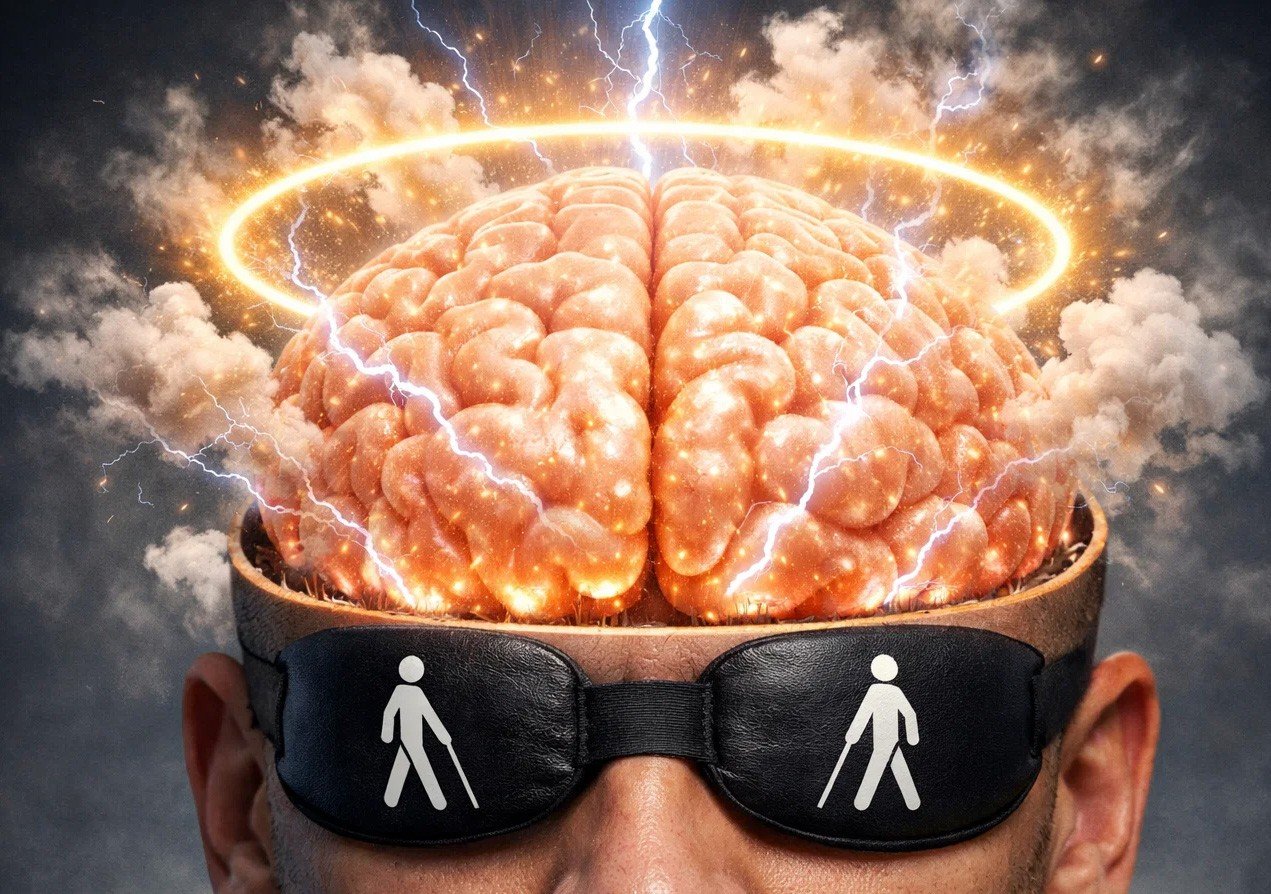
Once Nazified, eight decades later gripped by Coronoia: What causes bright minds to espouse outrageous nonsense, not out of calculation or coercion, but out of fervent conviction? Anyone who finds this incomprehensible misunderstands how the human psyche works. A high IQ does not protect against delusion—rather, it enables one to weave elaborate rhetorical garlands around it.
One of the most shameful chapters in German history is the widespread Nazification of the intelligentsia. Two ideologically blinded Nobel Prize winners led a campaign against “Jewish physics,” which they claimed was too abstract, too mathematical, wrote textbooks on “authentic German physics,” and rejected quantum mechanics and the theory of relativity because they undermined the “Germanic worldview.” Highly respected professors indoctrinated their colleagues with “biological foundations for racial studies and racial hygiene,” justifying the superiority of the “Nordic race.”
They used measurements to prove that the skulls and brains of Jews were “characteristically subhuman.” Archaeologists searched Nepal for “ancient Germanic peoples” from Atlantis. Doctors and biologists help to prevent the reproduction of “unfit” individuals; in the killing centers of the euthanasia program, they conduct “cutting-edge research” that uses murder as a source of material; in “hereditary health courts,” they decide on forced sterilizations, life, and death.
Lawyers legitimize the Nazis’ racial laws, theologians declare them to be God’s work: the Lord has made the Jews homeless and scattered them as punishment, so that they may atone under the rule of other peoples. They enthusiastically praise Hitler’s rise as a “gift and miracle from God,” as a “sunrise of divine goodness.” Celebrated thinkers such as Heidegger justified Nazi violence as a philosophical necessity and praised National Socialism as a “barbaric principle” that “enables greatness.”
Eight decades later, people shake their heads in disbelief: How could a large part of the intellectual elite in the Third Reich not only fall for the harebrained Nazi propaganda, but also actively spread it?
Elite in the grip of Coronoia
As if Germany’s schools had removed history lessons from the curriculum after 1945, a similarly monstrous absurdity repeated itself eight decades later, without anyone noticing the parallels. And once again, everyone joined in: from professors, doctors, and scientists to judges, teachers, editors-in-chief, publishers, and cultural figures to business leaders and senior civil servants.
Once again, unbiased, history-conscious contemporary witnesses were left in a state of bewilderment.
How could intelligent minds, instead of questioning the strangest pandemic of all time from 2020 onwards, uncritically support years of poorly justified scaremongering and obviously exaggerated, ineffective, and extremely harmful measures to combat the epidemic? How could they fail to understand why PCR tests are unsuitable for detecting infections? How could they confuse “corona-positive” with “sick”? How could medical professors persuade their students, chief physicians, their staff, and themselves to wear masks that protect against tiny creatures like viruses about as reliably as wire mesh wrapped around the head protects against mosquitoes and pollen? How could educated people seriously be impressed by the phrase that we are “defenseless against” the Covid pathogen as long as there are no vaccines—as if the human organism suddenly no longer had an immune system? How could they fail to examine approval studies to see whether they actually prove the efficacy and safety of Covid vaccines? How could they fall for predictions that people would soon be vaccinated, recovered, or dead?
How could intelligent people go along with being forbidden to be outside at night, to sit alone on a park bench without a mask, or to go for a walk? How could they be persuaded to believe in the threat of “overburdening the healthcare system” while hospitals were reducing the number of intensive care beds?
How could they believe that they needed to wear a face mask to walk from the entrance to their table in a restaurant – but could confidently take it off as soon as they sat down? How could they accept having to keep a distance of one to two meters from other people indoors, even though it was clear early on that SARS-CoV-2 spreads via aerosols that fill the room? How could they ignore numerous oddities that made a laboratory origin of this virus far more plausible from the outset than suspecting innocent bats, pangolins, raccoon dogs, and other animals as sources of the epidemic? (See my book Corona-Rätsel, published in June 2020.) How could they participate in the witch hunt against the unvaccinated and welcome the deprivation of their fundamental rights, when, in their opinion, there is nothing to fear once you have been “protected” by vaccination? How could they not be surprised that people infected with COVID-19 exceed their statistical life expectancy by an average of one to two years? How could they welcome lockdowns that have repeatedly proven ineffective in reducing incidence rates? How could they declare children to be “drivers of the pandemic” without a shred of evidence—and deeply traumatize them? Why did they refuse to learn from Sweden, Florida, and South Dakota that nothing bad happens without a state hygiene dictatorship?
In 1933 ff., as in 2020 ff., intellectual elites submitted to a grotesquely misguided regime, not out of coercion or calculated conformism – the majority of them went with the flow out of deep conviction, which they eagerly defended at every opportunity, arrogantly and mercilessly towards so-called “corona deniers.” In doing so, they endured and produced hair-raising logical distortions, refrained from asking the most obvious questions, ignored stubborn facts, and turned a deaf ear to well-founded counterarguments.
The human brain is not a truth machine, but a “social.”
Why does a high IQ apparently not protect against ideological blindness?
At least William von Hippel, an Australian social psychologist, is not surprised by this in the least. Human evolution, he explains (1), did not produce an impressive, enormously capable brain in order to recognize what is true, good, and beautiful. As a herd animal through and through, humans devote a large part of their mental capacity to finding their way in a complicated social world. Why is my neighbor looking at me so strangely today? Does it come across as flattery or appropriate appreciation when I praise my boss? How will this photo of me be received when I post it? What does my friend’s remark about my new watch mean? Who supports whom? How do I set boundaries? How do I dress appropriately for a particular occasion? Is the waitress flirting with me or is she just being particularly nice?
In short, we have a “social” brain under our skull. It does occasionally check facts. But what is much more important to it is to constantly probe: What social consequences will it have for me if I say, do, or refrain from doing this or that? Will it help or harm my reputation to be convinced of this or that? A biomachine is at work in our heads, which, in case of doubt, even prevents us from thinking the right thing if it jeopardizes our social status.
These psychological mechanisms are all the more powerful the higher the status of the person concerned. For particularly educated or wealthy individuals, an academic reputation or a high-level professional position is at stake. They have more to lose. That is why they are more concerned about how their opinions are received by others.
Against this backdrop, it is not surprising what a study on the collapse of the Soviet Union found: people with a university degree were two to three times more likely to have supported communist ideology than high school graduates, and employees were two to three times more likely than farm workers and unskilled workers.
A survey of 2,000 representative US Americans confirms the same phenomenon: the higher the level of education, the greater the concern about losing one’s job or ruining one’s employment prospects because of one’s political views. This makes people all the more willing to engage in self-censorship. Among respondents with a high school diploma or lower qualifications, only one in four was afraid of this, compared to 34% of college graduates and as many as 44% of those with higher academic degrees.
A clever mind rationalizes nonsense more skillfully
Although intelligent people are quite good at recognizing errors in others’ thinking, paradoxically, they are more prone to ignore their own cognitive errors. The smarter someone is, the more skillfully their brain sells even the greatest nonsense to them as reasonable and without alternative, as long as it benefits their status. They are better at rationalizing: they construct more complex, coherent stories from preselected information, both accurate and questionable. The more intelligent person is more convinced of their own objectivity and judgment, so they question themselves less often. They are better at defending their own beliefs, which they have arrived at for unreasonable reasons. (2) They use their cognitive resources to explain away evidence that contradicts their opinion. (3)
Being clever, they collect and process much more information than the mentally challenged – and use it to ingeniously confirm their preconceptions, even if they are on the wrong track. If his brilliant theory turns out to be a disaster, then of course it wasn’t the idea that was wrong, but reality that was inadequate. While the average person fails at assembling a Swedish shelf, the “bright mind” uses his cognitive overcapacity for far more ambitious projects: the construction of absolutely watertight castles in the air. Where the layman simply says “nonsense,” the intellectual needs five footnotes to elevate the same madness to the status of a universal formula. Thus remains the true tragedy of the highly gifted: no error is too stupid for them, as long as it can be explained in a sufficiently complicated way. A high IQ certificate, a doctorate, or an office on the executive floor are no guarantee of wise action, but often only a ticket to the club of smug ignorance. A diploma protects against folly as effectively as a sieve protects against rain—it just looks much better on the shelf.
Intelligence is a turbocharger, not a navigation system. It transports its owner’s mind faster – but unfortunately also faster in the wrong direction when the road is called “vanity,” “groupthink,” or “career.” And because the brightest minds are reluctant to err, they prefer to err elegantly, in keeping with their status: with diagrams, technical jargon, and peer review as a fig leaf. The end result is the most beautiful form of error: the kind that sounds so clever that no one dares to understand it. Those who disagree are considered uneducated – and those who agree are considered profound. In the ivory tower, stupidity takes an echo there for the voice of God, wears white coats and Louis Vuitton, speaks in the subjunctive, forms nested sentences, and eats third-party funds. “There are ideas so absurd that only an intellectual can believe them; no ordinary person would be so stupid,” as George Orwell noted.
In the “intelligence trap.”
And so a high IQ, education, and expertise do not protect against misjudgments, but actually promote them. (4)
Echo chamber effects in academic and media circles reinforce this tendency by sanctioning dissenters. Ambitious, up-and-coming scientists often find themselves under enormous pressure to conform among their colleagues. Those who stand out with controversial views, especially those that contradict the opinions of the luminaries in their field, the “opinion leaders,” risk losing research contracts, find it more difficult to get their work published, squander career opportunities, and are less likely to be invited to speak at important conferences. In an act of “high-level self-deception” (5), a clever mind therefore prefers to use its logic to justify the dogmas of its “community” rather than to examine them. The same applies to doctors in the hospital hierarchy, members of editorial boards, teachers in the faculty, members of parliament within their parliamentary group, and civil servants in public authorities.
For all these reasons, the intellectual elite is more inclined to subscribe to crazy ideas than so-called “ordinary people” such as craftsmen and taxi drivers, salespeople and postmen, cleaning ladies and warehouse workers. Simpler minds often have a better grasp of reality and common sense. The ideological follower is more likely to be found in lecture halls and executive offices than in factory canteens or at the regulars’ table.
“As if I had blasphemed against the Almighty.”
In the 1930s and 1940s, US journalist William Shirer (1904-1993) traveled through Nazi Germany to report on the Third Reich for the American media. (6) From there, he wrote: “I often had conversations in German homes or offices, sometimes informally with strangers in restaurants, beer halls, or cafés. I heard the most outlandish claims from seemingly educated and intelligent people. It was obvious that they were repeating nonsense they had picked up on the radio or read in the newspapers. Sometimes I was tempted to say so, but I was met with such disbelief, as if I had blasphemed against the Almighty.” Would Shirer have fared differently in the coronoid Lauterbach/Drosten-Schland of the early 2020s?
Notes
(1) William von Hippel: The Evolution of Cooperation: How Humans Became Cooperative (2020); The Social Paradox (2024); W. von Hippel/R. Trivers: “The evolution and psychology of self-deception,” Behavioral and Brain Sciences 34(1) 2011, 1–16. (Discusses why our brains developed self-deception as a social strategy to deceive others more effectively; thus addresses brain functions that are evolutionarily tailored to social interaction.) Forgas, J. P., Haselton, M. G., & von Hippel, W. (Eds.): Evolution and the Social Mind: Evolutionary Psychology and Social Cognition(2007). Includes a chapter on the social brain hypothesis.
(2) See Michael Shermer: Why People Believe Weird Things (2002); idem: “Smart People Believe Weird Things,” Scientific American, Sept. 1, 2002.
(3) See Ziva Kunda’s review of this phenomenon: “The case for motivated reasoning,” Psychological Bulletin 108 (3) Nov. 1990, pp. 480-98, doi: 10.1037/0033-2909.108.3.480.
(4) David Robson describes this “intelligence trap” in his book The Intelligence Trap: Why Smart People Make Dumb Mistakes (2019).
(5) Gurwinder Bhogal: “Why Smart People Believe Stupid Things,” February 14, 2023.
(6) Shirer’s best-known books: Berlin Diary: The Journal of a Foreign Correspondent, 1934–1941 (1941), a reportage-style eyewitness account from Berlin; The Rise and Fall of the Third Reich: A History of Nazi Germany (1960), an influential comprehensive work on the history of the Nazi regime, winner of the National Book Award (1961), among other honors.