
by Dr.Harald Wiesendanger– Klartext
What the mainstream media is hiding
A 64-year-old man learns that he has a particularly aggressive, advanced prostate cancer with bone metastases. Doctors declare his case hopeless. But he does not give up. He fasts strictly for six weeks, then changes his diet and takes a sophisticated mix of dietary supplements. And he survives. He is now considered completely cured – nine years after his terrifying diagnosis. Worth emulating?

Until 2016, Guy Tenenbaum, a French-American real estate project developer, seemed to have secured a permanent place on the sunny side of life. After retiring with a lot of money, he led a carefree, happy, luxurious life near Miami, Florida. He enjoyed spending his free time with good friends in fine restaurants.
However, his eating habits eventually took a toll on his health: Tenenbaum became severely overweight and developed high blood pressure and diabetes. After two years of increasing pain in his ribs, which he tried in vain to numb with pills, he finally had a thorough check-up. A PSA test revealed an alarmingly high value of 57. His family doctor immediately sent him to the hospital for a biopsy. Afterward, it was clear: Tenenbaum had stage 4 prostate cancer with a Gleason score of 9, the most aggressive type. The tumor had already spread to his skeleton; six metastases were growing in his ribs, and others were in his lymph nodes. “My urologist said to me, ‘Okay, there’s nothing more we can do—why did you wait so long?’” An oncologist told him, “You know it’s too late. You’re going to die soon—in six months, I guess.”
Shocked, Tenenbaum traveled to Strasbourg, his birthplace, to get a second opinion. After a CT scan and further examinations, his trusted doctor gave him the same fatal prognosis: “No chance—I can’t give you anything because you’re already as good as dead. But don’t worry, we have a good medication to ease your pain until then.”
Give up? Out of the question.
So that was it?
Tenenbaum didn’t think about giving up for a moment. “The day after I returned to the US, I thought: This is impossible, I won’t accept it!”
He came to the conclusion that since no one else was going to save him, he would have to take matters into his own hands. And he did so with enormous curiosity and perseverance. He conducted extensive research in PubMed, a free online database of medical literature with access to over 35 million scientific articles. He studied the work of Thomas Seyfried (1) and examined the research of Otto Warburg (2) and Wilhelm Brünings (3). From his reading, he concluded that cancer is primarily a metabolic disease—and therefore can be influenced by diet.
Finally, Tenenbaum came across the phenomenon of autophagy: a natural recycling and cleansing process in our bodies in which cells break down their own damaged components. The fundamental mechanisms of this process were discovered by Japanese scientist Yoshinori Ohsumi, who was awarded the Nobel Prize in Physiology or Medicine in 2016 for his work. Since then, many studies have built on Ohsumi’s groundwork, applying it to cancer and proving that autophagy is activated by fasting and can help fight tumors.
Six weeks of only water
Guy Tenenbaum put this knowledge into practice. Starting on January 19, 2019, the then 67-year-old consumed nothing but water for 42 days. He lost 25 kilograms in the process.
Since then, he has continued to fast persistently, albeit not constantly: sometimes 48 hours of fasting per week, sometimes 72 hours of fasting per month, sometimes 7 days of fasting in a row every two months, or with a mini eating window of just one hour per day. During fasting phases, he continues to consume plenty of water, green and herbal tea, sufficient electrolytes, such as salt – one and a half teaspoons of Himalayan salt per day – trace elements; vitamins C, B complex, D, E, K2; and omega-3.
The rest of the time, he eats a predominantly ketogenic diet, i.e., low in carbohydrates and high in fat. This puts the body into a metabolic state of ketosis, in which it derives most of its energy from fats rather than carbohydrates. This deprives cancer cells of their favorite energy source: sugar.
This process is supported by two metabolic supplements that Tenenbaum swears by:
– Alpha-lipoic acid (ALA): 1.8–4.0 g/day, slowly increased over about three weeks. ALA protects against harmful free radicals and helps the cell powerhouses—mitochondria—to work better.
– Hydroxycitrate (HCA) from Garcinia cambogia: 1.2–3.0 g/day, also gradually increased. HCA blocks an enzyme that the body needs to convert sugar into fat—a process that many cancer cells love, as they constantly need new building blocks to continue growing. HCA can disrupt this “supply route” and thus slow down tumor growth.
In addition, Tenenbaum swears by a whole cocktail of other dietary supplements that he believes protect mitochondria, reduce inflammation, and support the immune system:
– Red algae: 8 g/day: a blue-green microalgae rich in protein, iron, vitamin B12, omega-3 fatty acids, chlorophyll, and antioxidants, which have antiviral and anti-inflammatory effects.
– Spirulina: 10–14 g/day: a blue-green cyanobacterium rich in protein, iron, vitamin B12, chlorophyll, and antioxidants. It strengthens the immune system and aids in detoxification.
– Black cumin oil (Nigella sativa): 500 mg, twice daily.
– Garlic/allicin: 500 mg, 4×/day, alternatively plenty of fresh/fermented garlic.
– Green tea/EGCG as additional glutamine inhibitors.
Tenenbaum also relies on broccoli sprouts, curcumin, ginger, and quercetin, a secondary plant substance found in many fruits and vegetables, known for its antioxidant, anti-inflammatory, and cell-protecting properties.
“Keep doing what you’re doing.”
What was the result of all this? Complete remission. Tenenbaum’s PSA level has long been stable at 0.1. He has been symptom-free for nine years now, the tumor and metastases have disappeared without a trace, and the man is considered cured. “My oncologist kept telling me, ‘Whatever you’re doing, keep doing it.’”
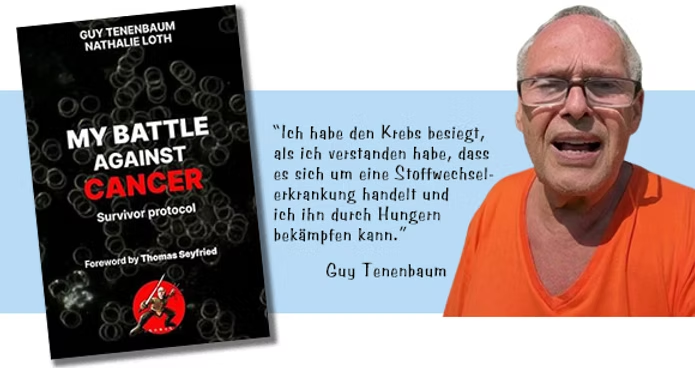
The exemplary self-healer recounts his path to survival, indeed to complete recovery, in his book My Battle Against Cancer: Survivor Protocol, published in 2023. He wrote it “primarily with the aim of helping all patients and giving hope to those who, like me, have been left to their sad fate by traditional medicine.” His YouTube channel SurviveFromCancer, with 370,000 views and 16,000 subscribers, features around 200 videos. Tenenbaum sums up his recipe for success: “I defeated cancer when I understood that it was a metabolic disease and that I could fight it by starving it.”
Warning against blind emulation
Nevertheless, Tenenbaum’s success story is an isolated case, and other cancer patients should be wary of making hasty generalizations. Every tumor is different. Type, genetics, stage, growth rate—what slowed down his particular cancer may be ineffective for another tumor. And every body is different: age, weight, organ damage, and medication all play a role in determining the course of treatment. No two metabolisms or immune systems are exactly alike. What suits one person may not suit another. What helps one person dramatically may do little or nothing for another. The dosages chosen by Tenenbaum are high and could interact with each other and with other medications taken at the same time. Clinical evidence is limited.
For some patients, a strict fasting regimen causes significant, well-documented problems. In a study of 652 patients—including cancer patients—who fasted on water under medical supervision, 27.6% experienced severe side effects. These often included severe fatigue, headaches, nausea, circulatory problems, and even near-fainting.
Reviews on fasting during cancer therapy have shown that many patients tolerate water fasting poorly; they develop headaches, nausea, dizziness, anemia, and weakness, among other things.
Strict fasting can be beneficial for people with a robust constitution. In an already weakened organism, however, it can cause dangerous complications, promote sarcopenia—further muscle mass loss—and damage the immune system. Oncologists warn enthusiastic Tenenbaum imitators against blindly experimenting on their own, without sound knowledge and medical supervision, and for good reason.
It would be wiser to fast as a preventive measure, while the body is still largely healthy and able to cope with extensive starvation. In animal experiments, even a reduced calorie intake – without malnutrition – lowers the incidence of tumors by 20 to 60%. In mice, intermittent fasting significantly inhibits the development of liver and colon cancer. In two human studies, lifelong reduced calorie intake was associated with a lower risk of breast cancer. Among 2,413 women with early breast cancer, those who did not eat for more than 13 hours a day were less likely to relapse. As always, prevention is better than cure.
Notes
(1) Thomas N. Seyfried, an American biologist and professor of biology/genetics/biochemistry at Boston College, focuses his research on cell and metabolic biology, particularly the lipid and mitochondrial biochemistry of cancer cells. Seyfried sees cancer primarily as a metabolic disease, not primarily a genetic one. See his book Cancer as a Metabolic Disease: On the Origin, Management and Prevention of Cancer(2012).
(2) German biochemist, physician, and physiologist Otto Heinrich Warburg (1883-1970) received the Nobel Prize in Physiology or Medicine in 1931 for his work on cellular respiration. Among other things, he studied tumor metabolism and formulated the so-called “Warburg effect” hypothesis: tumor cells generate energy primarily through fermentation (glycolysis) rather than oxidatively via the mitochondria. See his book Stoffwechsel der Tumoren (1930).
(3) Wilhelm Brünings, a German physician, described a so-called “desugarization method” as early as the 1940s: a ketogenic, i.e., extremely low-carbohydrate diet for tumor patients. Cancer cells can be “starved” by depriving them of sugar (glucose), thereby attacking their metabolism. Brünings’ work is now considered a historical precursor to metabolic therapies in oncology. See Rainer J. Klement: “
,” Journal of Traditional and Complementary Medicine 9 (3) July 2019, pp. 192-200, https://doi.org/10.1016/j.jtcme.2018.06.002