
Noel* developed severe epilepsy in his first year of life. For four years, medication had no effect except for fatal side effects. The boy only made astonishing progress after attending AUSWEGE/WAYS OUT therapy camps.
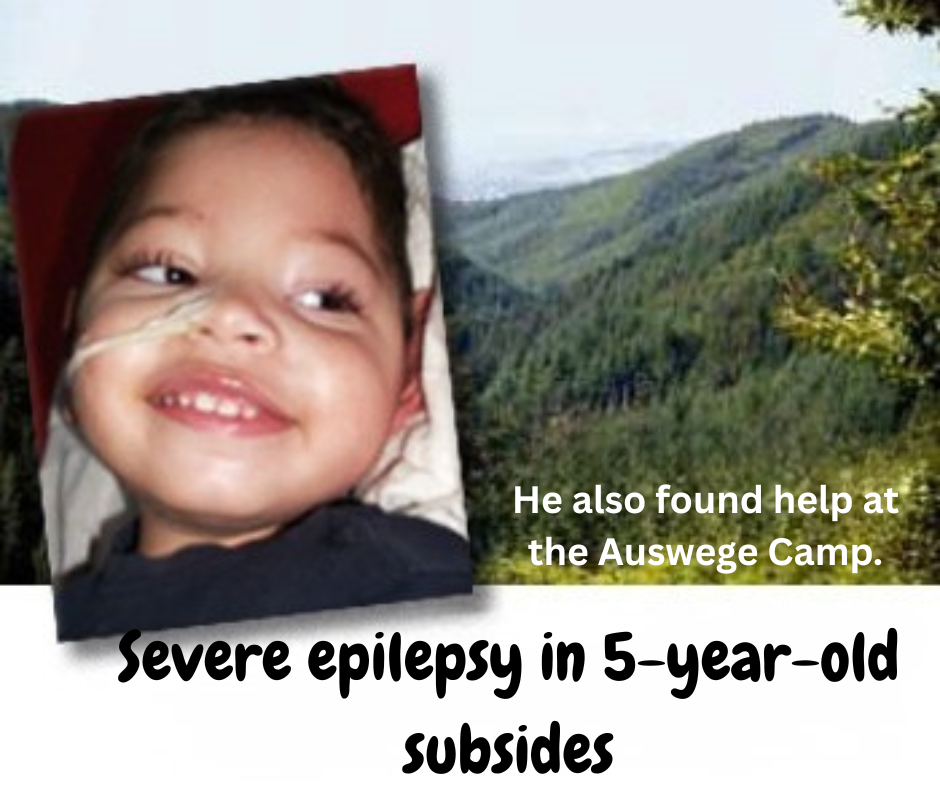
At six months old, Noel* began experiencing severe seizures characteristic of West syndrome: a
rare, particularly difficult-to-treat form of epilepsy named after British physician William West, who first described this clinical picture in 1841 after observing it in his own son. Typically, it leads to a series of “BNS seizures” (“Blitz-Nick-Salaam”), which travel through the body like lightning and have three
characteristics: sudden muscle twitches in which the arms and legs shoot up and forward, the head and upper body move forward (lightning seizure); the head jerks forward (nick seizure); the arms twitch upward and bend, bringing the hands together in front of the chest (salaam seizure).
Three months later, Noel’s epilepsy reached its peak: he had dramatic seizures several times a day,
lasting two to six hours (!).
The little boy’s daily routine at that time was sleep, convulsions, and then sleep again. From then on, his mental and physical development stagnated. The little boy’s daily routine at that time consisted of sleeping, convulsing, and then sleeping again. From then on, his mental and physical development stagnated. “He has no control over his body; he can’t move his arms and legs in a coordinated manner, he can’t hold his head up,” his mother reported a year after the onset of epilepsy. “He hardly makes contact with the outside world: he doesn’t smile at you, doesn’t look at people properly, doesn’t follow objects with his eyes, doesn’t react to noises.” Of course, “we tried various medications, but stopped some of them because they didn’t bring any improvement.”
“An indescribable gift for us”
Noel was just under two years old when his parents took him and his brother, who is two years older, to a therapy camp run by the AUSWEGE/WAYS OUT Foundation for the first time – with such encouraging results that they returned the following year.
Each time, Noel’s epileptic seizures decreased significantly, occurring less frequently and lasting for shorter periods. His medication could be reduced. “There were weeks when Noel didn’t have a single major, visible seizure,” his parents noted. What’s more, their boy had “really changed. He has become much more alert. Some days he smiles a lot, sometimes he literally beams. We can see how he is getting more and more energy and waking up. It’s an indescribable gift for us.”
Unfortunately, this was followed by repeated setbacks – and so the parents hoped for a third therapy camp. But they didn’t have the money for it.
That’s when our “HERZENSFONDS” stepped in: it covered the costs of counseling and treatment, accommodation, and meals. A month later, his mother summarized how much this had benefited the boy in an email: “He’s been doing great for four weeks now. At first, I didn’t trust this positive development; I had somehow always feared that things would get worse again. But his seizures have continued to decrease. He hasn’t had any severe seizures at all in the last few weeks. And it’s also completely new that his seizures sometimes only last a very short time – a few seconds – and then he’s back and smiling.
Previously, when he started convulsing, he couldn’t come out of it on his own. It took some time in our arms for him to calm down. He has also become more alert and smiles a lot. His physical therapist also noticed that something had happened to Noel and that he had developed. (…) We have been richly blessed. I don’t even want to imagine how we would be today if Noel hadn’t gotten a therapy spot with you.”
(*: pseudonym)


https://secure.spendenbank.de/Form/3867?lang=2