
Over the course of a decade, a 50-year-old man suffered from severe depression. It wasn’t conventional psychiatry that brought him relief, but medicinal plants and dietary supplements — and above all, a healing week at an AUSWEGE/ WAYS OUT therapy camp.
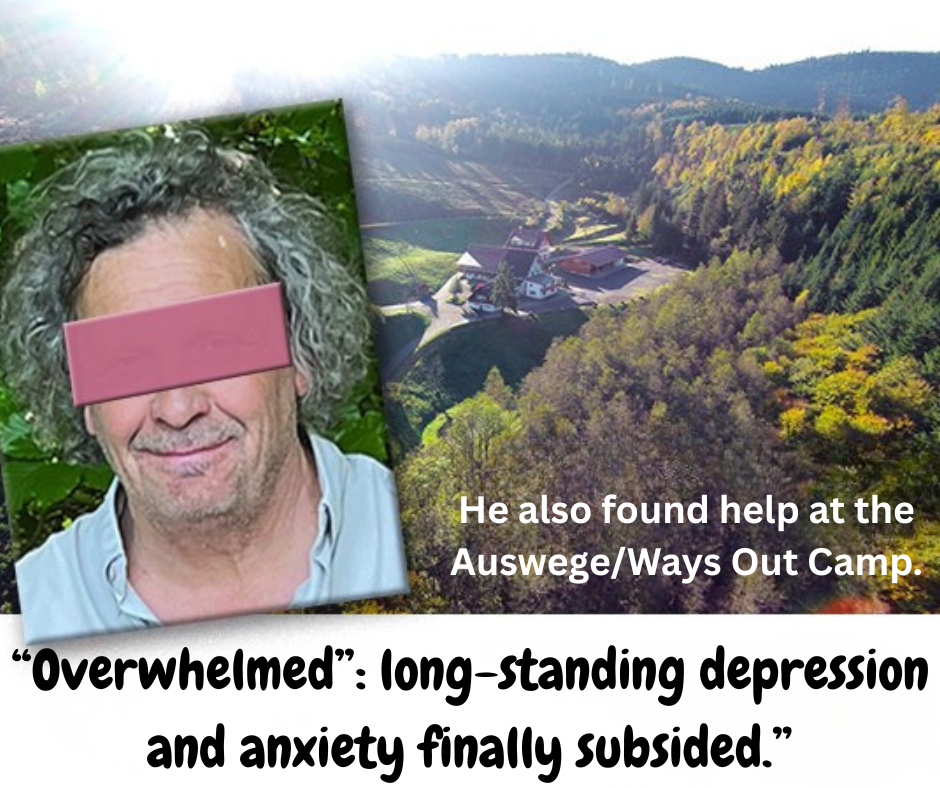
For 12 years, Bernd*, a craftsman from the Odenwald region, suffered from recurring depression. During such low points, he says he felt “unable to cope, listless, anxious, joyless, tearful.” He was downright afraid of social contact. Inpatient hospital stays and outpatient treatment brought him “no long-term success.” Phytotherapeutics were more helpful: Rhodiola rosea (“rose root”), saffron, and Griffonia 5-
HHTP, extracted from the seeds of a West African plant whose main active ingredient, 5-HTTP, is an intermediate in the body’s production of serotonin, the so-called “happiness hormone.”
A psychiatric clinic diagnosed Horst with “bipolar affective psychosis,” but without evidence of manic
phases. Bernd does not blame anyone else for his mental health issues. “I inherited this predisposition from my father. I always wanted to prove something to him. My mother pampered me—she wanted to protect me above all else.”
In his first marriage, which ended in divorce in 2022 after 44 years, “difficult verbal exchanges” were the norm. Bernd counts “excessive helpfulness, false priorities, little to no self-care” and a constant inner compulsion to “increase self-esteem through performance” among his “harmful lifestyle habits.” His “beliefs” include: “The needs of others are more important than my own“ and ”To be recognized, I have to be good.” In the summer of 2025, during a particularly severe depressive phase, the now 63-year-old decided to participate in a therapy camp run by the Auswege Foundation, accompanied by his partner.
There he learned about unconventional approaches to freeing himself from his psychological baggage: he experienced healing sessions with acupuncture, water shiatsu, trauma therapy, deep relaxation,
healing coaching, physical therapy, and energy balancing techniques, image and Gestalt therapy, educational development therapy, and spiritual healing.
He already benefited from this during the camp week: the symptoms of his depression “have significantly decreased,” he noted in a patient questionnaire at the end of the camp.
His general mood, indeed his entire state of mind, had improved considerably, and his fear of contact had diminished. This camp had given him new confidence and self-assurance.
Was this merely the fleeting wellness effect of a relaxing week’s vacation in an idyllically located forest guesthouse, supported by a loving therapeutic community?
Fortunately, the significant improvement continued, as Bernd’s partner wrote four weeks after the camp ended: “Since we’ve been home, he’s actually been doing much better. He’s back at work and taking care of his garden. The camp was a complete success for him. Finally, after five months of depression, I’m seeing Bernd cheerful and upbeat again. I am infinitely grateful that this camp had such a healing effect.“ Two and a half months later, she reported: ”Bernd is now able to manage his daily tasks again, and his mood remains good. The camp stay was the catalyst for this. He is still overwhelmed by the impressions. We are happy!”
(*: pseudonym)


https://secure.spendenbank.de/Form/3867?lang=2