
by Dr.Harald Wiesendanger– Klartext
What the mainstream media is hiding
A stricter “epidemic law” is set to introduce compulsory vaccination, with those who refuse facing five-figure fines – in Switzerland. Unthinkable in Germany? The unspeakable years of COVID-19 give us plenty of reason to expect the worst here too, as soon as the WHO declares the next pandemic.
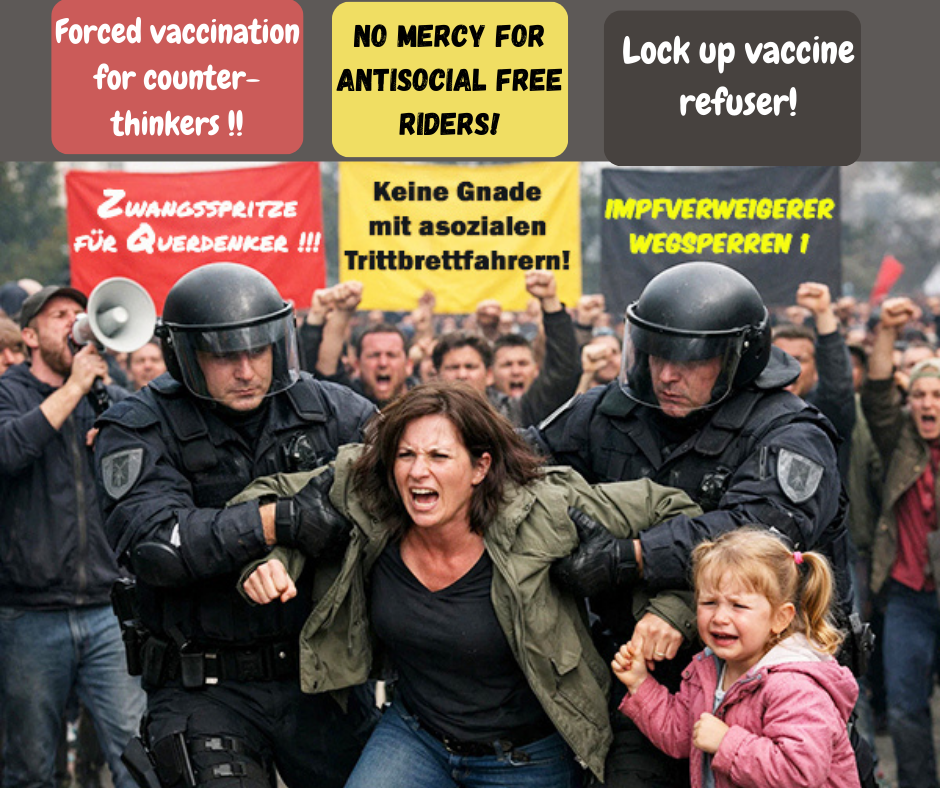
After the pandemic is before the next one. So it is important to take precautions, and that is precisely what our Swiss neighbors are currently striving to do. The Swiss parliament is debating an “epidemic law” that is intended to “further develop” a predecessor that has been in force since 2012. The project is a big one: in the event of a “special threat to public health,” such as the threat of ‘overloading’ the healthcare system, the Federal Council can not only order “necessary measures,” but also enforce them by means of severe sanctions: from surveillance, isolation, and quarantine of individuals, groups, or the entire population to “mandatory vaccination.” A fine of up to 10,000 Swiss francs, equivalent to just under 11,000 euros, threatens anyone who refuses to be “isolated,” violates “cooperation obligations,” violates travel regulations—or refuses to be vaccinated.
Admittedly, the jab is not to be enforced by force. But those who resist must be prepared to pay a hefty fine. Individual cantons have already drastically increased the federal penalties: up to 20,000 francs in St. Gallen and 50,000 in Zurich. In the canton of Vaud, health law even allows for maximum fines of up to 200,000 francs.
Wouldn’t that be no coercion at all, even without handcuffs?
Major media outlets defend the horrendous fines. Without “effective sanctions,” argues the Tages-Anzeiger, the mandatory requirement would be “toothless.”
Representatives of the medical profession also welcome the hammering of measures. The “threat of a fine” should “encourage the last unvaccinated people to get vaccinated – ideally without actually enforcing the penalty,” explains Christoph Berger, chief physician of the Department of Infectious Diseases and Hospital Hygiene at the Children’s Hospital in Zurich and president of the Federal Commission for Vaccination Issues from 2015 to 2023.
Among the Swiss population, however, resistance appears to be growing. In a survey conducted by the online information service Portal 24, 92% of participants rejected the de facto vaccination mandate.
Would a popular uprising break out in the Alpine Republic if lawmakers implement their plans? Doubts are justified. The survey was not representative – it is likely that it was mainly those Swiss citizens who are angry about what is in store for them who took part. During the coronavirus pandemic, the gullible and obedient clearly predominated between Schaffhausen and Geneva. 69% of the population received at least one vaccination against Covid-19, and 56% received a “booster.”
What the WHO understands by “pandemic” guarantees the next
And in Germany? Unlike between 2020 and 2023, would there be a broad wave of protest against the authoritarian excesses of state disease control authorities?
The German “Infection Protection Act” has long since opened the door to such aspirations: Section 20 authorizes governments to order their people, or at least “threatened sections of the population,” to participate in protective vaccinations if a serious ‘communicable’ disease spreads.
When is such a danger imminent? When the World Health Organization, to which the Federal Republic of Germany has been a loyal member since 1951, declares a “pandemic.”
Under what conditions does the WHO do this? Surprisingly, not only “in the event of an enormous number of deaths and illnesses.” In 2009, the WHO quietly replaced this older definition, which was based on the actual damage caused, with one that made the coronavirus alarm possible in the first place: It is sufficient for a new pathogen, however harmless, to “spread worldwide.”
According to the “International Health Regulations,” the World Health Organization cannot mandate compulsory vaccination to its member countries, but it can strongly recommend it.
If German politicians implement WHO guidelines as obediently during the next pandemic as they did during the coronavirus years, will they not follow the Swiss example and threaten vaccine refusers with drastic penalties?
“Kick them in the butt.”
What elected representatives said at the time gives rise to fears of the worst. The astonishing “health expert” of the Green Party, Dr. Janosch Dahmen, called for mandatory vaccination “for everyone over 18”; however, he said it would only make sense “with fines.” Bavaria’s Markus Söder thought it was “naturally good if mandatory vaccination would also take place, at least for those for whom the vaccine has already been tested – from age 12 onwards.” North Rhine-Westphalia’s Minister President Hendrik Wüst (CDU) said that compulsory vaccination must be “sensitive” – in other words, it must have noticeable consequences. Winfried Kretschmann, Baden-Württemberg’s Green Party leader, openly advocated a ruthless approach: rigorous ‘vaccination’ must be carried out, then the matter would be “settled.” Robert Habeck (Green Party) said in 2021: “Those who are sluggish should finally get a kick in the butt.”
The then German Chancellor Olaf Scholz (SPD) argued in the Bundestag on January 13, 2022, that Covid-19 vaccination should be made mandatory for all adults. In the same month, Green Party member Ricarda Lang demanded: “A general vaccination requirement from the age of 18 must be introduced” in order to “stop sliding uncontrollably from wave to wave.”
Karl Lauterbach, the tireless spokesperson for the hardline pro-vaccination faction, also did not think much of voluntary persuasion—mandatory vaccination was the “safest and fastest way out of the pandemic” to prevent future waves. “Only in this way will we regain our freedom.”
Strict controls were planned via a national vaccination register, employers, authorities, and an army of volunteer informants. For those who refused to be vaccinated, fines were planned, as in Switzerland, rather than physical violence or coercive detention. Lauterbach emphasized: “No one has to go to prison” (except himself, albeit for other reasons). Fines were to be “severe,” based on the measles requirement—up to €2,500, or higher in case of non-payment.
In cases of persistent refusal, legal experts such as Gunnar Duttge and Kathi Gassner considered prison sentences of up to two years conceivable, analogous to § 316 of the Criminal Code for “dangerous behavior.” In 2021, Tübingen’s Green mayor Boris Palmer advocated “coercive detention” and batons against lateral thinkers at demonstrations. (1) Saxony’s Minister of Social Affairs declared it ‘necessary’ in “individual cases” to lock up quarantine refusers in psychiatric wards – why not also unyielding vaccine refusers?
Would the use of force be unthinkable, completely out of the question? Have we already forgotten how brutally police officers beat up “lateral thinkers” during the mass demonstrations in Berlin in August and November 2020? Have we already forgotten that coronists in office and positions of authority threatened to “use direct coercion, i.e., the use of simple physical force, physical force aids, or weapons” against people? This attempt at intimidation, undertaken by a mayor in early 2022, applied to participants “at all public outdoor events” in the city area “to ensure that the ban on assembly is observed” – why should vaccine refusers be spared?
“What else?”
Major media outlets almost unanimously supported a hard line, with millions being spent on pro-government “fact-checking.” “What else?” was the headline of a 2020 Spiegel column on compulsory vaccination, which it described as “like a society-wide ticket inspection for free riders.” The Süddeutsche praised compulsory vaccination as a possible “emergency exit” from ongoing restrictions on fundamental rights. The taz found it “reasonable,” while the Tagesspiegel called for it “promptly.” It “has to happen, and quickly,” said the Stern. “Sorry, but unfortunately there seems to be no other way. And the nightmare would soon be over. Finally.” As was once the case with smallpox and polio: “If necessary, the police came.”
Would the majority of Germans resist such whisperings during the next “pandemic,” whereas most tended to be obedient followers during the coronavirus pandemic? Doubts are appropriate. Vaccine skepticism has grown since word got around about the legions of people suffering long-term damage and deaths caused by the Covid vaccination campaign. But how many will retain their critical thinking skills—once known as “lateral thinking”—when propagandists once again stir up mass panic worldwide, warning of a “killer germ” that seems even more terrible than SARS-CoV-2, and promoting great new vaccines that this time are definitely absolutely effective and safe? Will the impression prevail once again that we are “defenseless” against a pathogen as long as there are no vaccines – and that “herd immunity” can only be ensured if we prevent even the last vaccine skeptics from leaving the herd?
At the height of the general coronia, 80 to 90% of the population – from cleaning ladies to chief physicians, from taxi drivers to university professors – went along with the government’s hygiene terror. The majority even considered it “not far enough,” with only a few finding it “excessive.” At times, 59% “wanted a hard lockdown as soon as possible.” 87% thought it was right to extend the mask requirement. 78.4% were in favor of “locking down” “particularly affected” communities—i.e., those with a certain tested “incidence.” 90% considered social distancing rules to be necessary. 85% had been “vaccinated” against Covid-19 at least once. At the end of 2021, 69% were in favor of “everyone having to be vaccinated against Corona.” People were insulted and denounced for sitting alone on a park bench outside without a face mask or for going for a “illegal” walk. Hatred and agitation against “Covidiots” and “anti-social freeloaders” reigned supreme. The majority advocated more controls, greater pressure – for example, through 2G/3G rules, access restrictions, distancing regulations – and tougher penalties. (2) 61% called for “fines for people who skip their vaccination appointments.” In order to break resistance to vaccination, coercion took place on a massive scale: whether in companies, where job losses were threatened, or in retirement and nursing homes, where rebellious seniors faced expulsion.
Is all this supposed to have been no coercion? Do we enjoy the sacred freedom of choice of a democratic constitutional state as long as we are not shackled, beaten, or imprisoned?
Blindly heading toward the next hygiene dictatorship
Unthinkable in the next pandemic? Has public opinion changed significantly since 2020/21/22—especially since everyone now knows someone who has been disabled or killed by the Covid vaccine?
Anyone hoping for learning effects underestimates the lasting power of propaganda. Even in April 2024, 70% would have supported compulsory vaccination in retrospect. Furthermore, every second person is against the “critical review” of the Corona period; 55% see no benefit in it. At the beginning of 2025, a large majority, over 70%, still rated Germany’s pandemic management positively. Do you have to be a conspiracy theorist to dread the next WHO-staged bat horror in the midst of such a reflection-phobic community?
Notes
(1) https://www.youtube.com/watch?v=tPPtRrOB1j4&t=3s https://www.youtube.com/watch?v=uvc24A7pjwE&t=1s
(2) https://www.tagesschau.de/inland/deutschlandtrend/deutschlandtrend-2503.html, https://www.forschungsgruppe.de/Umfragen/Politbarometer/Archiv/Politbarometer_2020/Oktober_II_2020/