
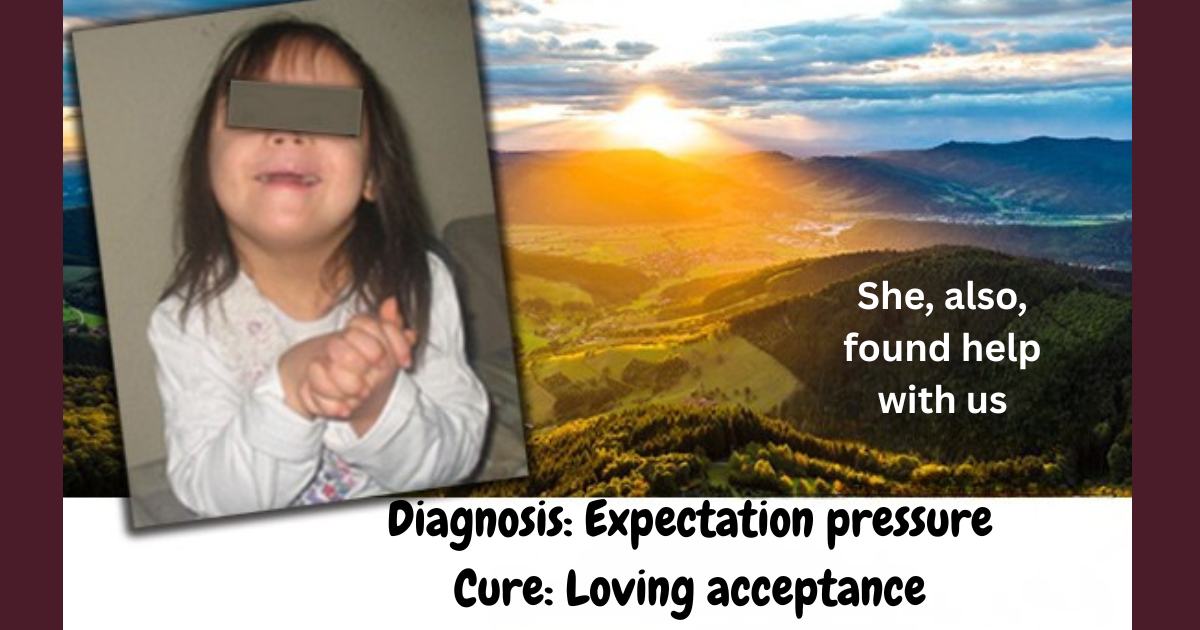
Sometimes healing occurs even though symptoms do not subside in the slightest. This
is illustrated by the case of six-year-old Jasmin*, who arrived at an AUSWEGE/Ways Out therapy camp
with severe Down syndrome.
Down syndrome involves a genetic abnormality— trisomy 21—in which chromosome 21 is present in triplicate rather than in duplicate in all or some cells. In Germany alone, there are up to 50,000 people affected. This condition is associated with typical physical features, delayed development, and usually mild to moderate intellectual disability.
In Jasmin’s case, it was accompanied by a congenital heart defect. In addition, the child was hard of hearing—severe in the left ear and mild in the right. She had vision problems: her eye lens was cloudy, and she squinted severely. Due to a weak immune system, she suffered constantly from infections. In terms of her intellectual development, “she is at the level of a two-year-old,” her father wrote to us.
“Other children with Down syndrome are much stronger and more advanced than she is. I also have the
feeling that she feels confined in her poorly functioning body and wants to free herself from it.”
Diagnosis: expectation pressure.
Healing: Loving Acceptance
And so the father persistently pestered us for months to give his daughter a spot in the therapy program— he saw this as a wonderful opportunity for healing, especially since so many great healers were gathered at our camp.
Since we feared his enormous expectations would only be disappointed and might lead him, out of frustration, to poison the camp atmosphere, we initially turned him down. We only agreed to Jasmin’s participation after he informed us that he could not travel here for professional reasons and would leave it to the grandparents to accompany his daughter.
No sooner had she arrived than the little girl became the sunshine of our therapy week: always cheerful and well-balanced, curiously exploring her surroundings, with a beaming smile that was contagious to us all.
The medical director of the therapy camp described her as “calm, well-balanced, harmonious.”
This child was obviously happy— unlike her relatives, who had hoped that we would magically make the Down syndrome symptoms disappear as quickly and completely as possible. Who needs healing here? The disabled child? Or rather her primary support system, which impatiently confronts her with unfulfillable demands— and then resents her when she doesn’t meet them—instead of being proud and happy about what this girl is capable of despite her disabilities?
When the “cure” turns out to be something completely different from what was expected
By the end of the camp, there had not been the slightest change in Jasmin’s symptoms— but there had certainly been a change in her grandparents’ attitude. “They understood. And they are beginning to love their grandchild just as she is,” the camp doctor noted in conclusion.
P.S.: This and many other examples of the “systemic” approach of AUSWEGE/WAYS OUT
medicine can be found in Harald Wiesendanger’s book: AUSWEGE – Helping the Sick in a Different Way
(2015), 344 pages, A4 (with over 1,400 images), https://stiftung-auswege-shop.gambiocloud.com/auswege-kranken-anders-helfen.htmlhttps://stiftung-auswege-shop.gambiocloud.com/auswege-kranken-anders-helfen.html
(*: Pseudonym)