
by Dr.Harald Wiesendanger– Klartext
What the mainstream media is hiding
When the carotid arteries narrow, it becomes dangerous: there is a risk of stroke. Conventional medicine earns a fortune from drugs to treat carotid stenosis. A centuries-old, inexpensive natural remedy may be more effective: pomegranate. A promising small study on this topic has been hushed up for two decades, and no sponsor can be found for a larger study, especially not among drug manufacturers. Why should they research fruit when synthetic drugs guarantee billions in sales?
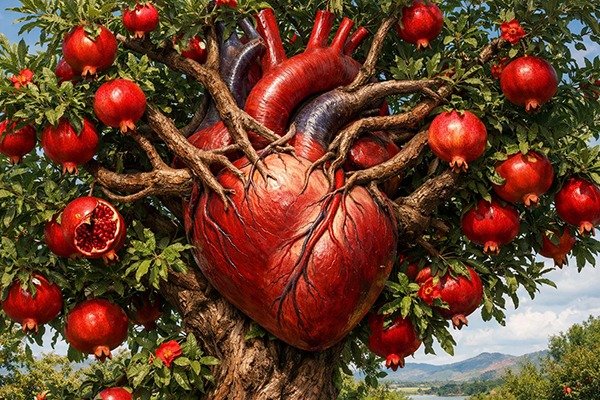
An intact garden hose is smooth and flexible, allowing water to flow freely through it. If fine rust, dirt, and limescale build up on the inside over time, it gradually becomes more brittle and narrower, slowing down the flow and increasing the pressure. If the hose becomes clogged, it may eventually rupture.
Something similar happens with vascular disease, which begins unnoticed and causes no symptoms for a long time, but can eventually cause paralysis or, in the worst case, death. Only those who have already been diagnosed with it are familiar with its name among laypeople: carotid stenosis. (1) This condition causes narrowing of the two large carotid arteries (arteria carotis) through which the heart pumps oxygen-rich blood to the brain. The cause is usually arteriosclerosis, which, according to current medical opinion, is caused by plaques of cholesterol, fat, and calcium that build up on the artery walls. When material detaches from these plaques, clots can form, which travel with the bloodstream and then block vessels.
Early stages, in which the diameter of the arteries decreases by less than 50%, remain symptom-free and are usually discovered by chance. Through a stethoscope, the doctor hears a “vascular murmur” (bruit): a rough, blowing, hissing sound, as if air were flowing through a narrow opening. Ultrasound makes the narrowing clearly visible.
Only when it progresses to more than 60 to 70% do symptoms appear. The first warning signs are dizziness, tingling, and slight disturbances of consciousness. The situation becomes really serious when transient ischemic attacks (TIAs) occur: these cause temporary visual disturbances on one side of the body – suddenly, one eye goes dark, “like a curtain falling,” say those affected – speech becomes difficult, and one half of the body feels numb. After a few minutes to several hours, these “warning signs” disappear completely. Often, this is just the deceptive calm before the fatal storm: when the artery is completely blocked, the blood flow to the brain stops, leading to a carotid-related stroke – around 20,000 to 30,000 times a year in this country.
Approximately 4% of all adult Germans have carotid stenosis of at least 50%, and from around the age of 65, the frequency increases to between 6 and 15%, depending on the study.
According to estimates, more than one million of these people require treatment, which is almost 1% of the total population.
What can be done? In cases of asymptomatic stenosis of less than 50 to 60%, conventional medicine focuses on reducing the risk with medication: They prescribe blood pressure medications such as ACE inhibitors, sartans, and calcium antagonists, cholesterol-lowering drugs—especially statins—and anticoagulants such as ASA or clopidogrel, along with the good advice to quit smoking, exercise more, and go on a diet. Patients simply have to put up with the typical side effects of the drugs, which include nausea, headaches, muscle pain or weakness, gastrointestinal complaints, bleeding, and allergic skin reactions. (2)
Is there another way? What does naturopathy have to offer?
Pomegranate: a therapeutic all-rounder
Pomegranates were used as a medicinal plant even in ancient times. Hippocrates and Avicenna used the bright red fruit to treat stomach problems, heal wounds, and reduce inflammation.
Ayurveda and traditional Chinese medicine have been using the root bark, peel, and pulp for at least 2000 years to treat numerous ailments, from ulcers and sore throats to parasitic infestations. An online database collects studies on the therapeutic value of pomegranate in treating over 300 diseases. Could pomegranate also be effective against arteriosclerotic damage to the heart vessels?
It has been over two decades since an Israeli professor of medicine addressed this very question: Michael Aviram. At the time, he was researching and teaching at the Technion, Israel’s oldest university and a leading institution with 19 faculties and 60 research centers spread across 300 buildings covering 1.2 square kilometers. Together with ten colleagues, Aviram conducted a study with 19 seniors—aged 65 to 75—whose arteries were already severely narrowed, by 70 to 90%. They had never been concerned about their health; they had been taking the usual medications for carotid stenosis for a long time and continued to do so.
The research team divided these 19 people into two groups that were matched in terms of age, blood pressure, lipid profile, glucose levels, and medication use. The starting point was therefore the same, as was the standard care. The two groups differed in only one respect: ten patients drank 50 milliliters of pomegranate juice every day for a year – equivalent to 10 teaspoons, or just a quarter of an espresso cup. Nine other patients formed the control group.
At the beginning of the study, and after three, six, nine, and twelve months, the researchers used ultrasound to measure the intima-media thickness (IMT) of the carotid artery: the standard value for the thickening of the two inner layers—intima and media—of the artery wall. Elevated IMT signals early arteriosclerosis, and thus an increased risk of heart attack and stroke. In young, healthy adults, IMT is between 0.5 and 0.7 mm; it increases by 0.1 to 0.4 mm per decade. Values above 1.0 mm are considered pathological. In Aviram’s pomegranate group, the average IMT before the start of the study was 1.5 mm.
What happened over the course of the following year?
Fruit beats pharmaceuticals
After three months, the IMT had decreased by an average of 13%.
After six months, it had decreased by 22%.
After nine months, it had decreased by 26%.
After one year, the reduction was up to 35% — the average IMT had decreased to 1.1 mm.
No, these are not typos. The trend had actually reversed, not just a little bit, but massively — despite unchanged diet and exercise habits.
Meanwhile, what happened to the control group, which continued to receive standard conventional medical care? The condition of their carotid arteries continued to deteriorate. Without pomegranate juice, their IMT increased significantly – from 1.45 to 1.52 to 1.65 mm.
The underlying biochemical changes that Aviram’s team observed were equally pronounced:
· Oxidized LDL – “bad” cholesterol that undergoes chemical changes under oxidative stress – can be deposited in the vessel walls and cause them to calcify. Its value decreased by a remarkable 90%. (LDL transports cholesterol from the liver to the body, while HDL transports excess cholesterol back to the liver.)
· What happened to paraoxonase-1 (PON1): an enzyme in the blood that the body produces mainly in the liver and kidneys to protect against harmful substances, especially aggressive molecules that can damage cells, such as free radicals? PON1 https://www.frontiersin.org/journals/cardiovascular-medicine/articles/10.3389/fcvm.2023.1065967/full binds https://journals.sagepub.com/doi/full/10.1089/ars.
2019.7998 to (“good”) HDL cholesterol and neutralizes oxidized fats in the blood vessels, thus preventing arteriosclerosis. This PON1 increased by 83%.
· Systolic blood pressure (3) decreased by 12%.
· The so-called total antioxidant status increased by 130%. (This value measures the ability of blood or other body fluids to neutralize free radicals and reactive oxygen species. Low values indicate oxidative stress associated with inflammation, aging, or diseases such as arteriosclerosis.)
Five patients in the treatment group drank the juice for another three years. Subsequent measurements confirmed that the improvements achieved after 12 months were stable. The 35% reduction in IMT remained unchanged. Meanwhile, markers for lipid peroxidation decreased by an additional 16% in the second year and continued to fall in the third and fourth years.
Aviram’s discovery therefore suggests two things: The usual medications for carotid stenosis do not have the effect that doctors believe they do. There are other, natural ways to heal narrowed arteries.
Weak point: too few participants
But what do findings from just 19 test subjects really mean? Students learn about test theory in their first semester: a small number of participants does not automatically render a study worthless, but it does make it significantly more susceptible to misinterpretation. Often, the sample is not representative, making it difficult to generalize the results. It lacks statistical power: there is a high probability that a real effect will be overlooked; conversely, seemingly “significant” results may more easily be coincidental. In addition, small studies provide wide confidence intervals, which means that even if an effect is found, it is often unclear whether it is small, moderate, or very large. It is difficult to base treatment decisions on such findings. Furthermore, small studies are quite susceptible to bias: individual outliers or differences between groups—e.g., age, medication, baseline risk—have a disproportionate effect on 19 subjects; even a few atypical individuals can significantly skew the results.
Nevertheless, they are useful for providing valuable insights—especially if they are methodologically sound and reveal a pronounced, plausible effect. Good mini-studies are hypothesis generators.
Plausible effect
Is the observed effect plausible? The way it developed suggests so. Biochemical changes occurred within the first month: the markers for oxidative stress shifted. It took much longer for the artery walls to change structurally. The IMT decreases followed a clear dose-response relationship: they were moderate within the first quarter of a year, then accelerated, and reached a maximum after one year. Is this merely a placebo effect? Rather, this one year seems to have been the natural time frame in which arterial biology normalized—the system gradually returned to physiological equilibrium. The tissue needed time to remodel itself.
What was the basis for the healing effect of pomegranate in Aviram’s study? Obviously, it had nothing to do with cholesterol levels. LDL levels remained largely unchanged in the test group. What changed was the effect of LDL – how strongly it was oxidized, how susceptible it was to further oxidation, how well antioxidant enzymes protected it.
Apparently, no high dose is needed to initiate and maintain this process. Ten teaspoons of juice a day may contain enough polyphenols to have a beneficial effect on oxidative stress throughout the body.
In Aviram’s treatment group, they apparently succeeded in restoring the redox environment in which arteries can heal themselves: the “chemical atmosphere” in cells and body fluids that determines whether electrons are more likely to be withdrawn (oxidation) or supplied (reduction).
This does not appear to require a high dose. Ten teaspoons of juice per day contain enough polyphenols to have a beneficial effect on oxidative stress throughout the body: tannins, anthocyanins, ellagitannins. They have a beneficial effect on enzymes and cell signaling pathways — e.g., inflammatory and stress responses — as well as endothelial function, blood pressure, and lipid oxidation. They promote PON1, the enzyme that removes lipid peroxides from the vascular wall. And they enhance glutathione, the most important antioxidant within the body’s cells: it neutralizes free radicals and regenerates other antioxidants such as vitamins C and E.
Although the Aviram study did not provide conclusive proof of all this, it did provide a remarkable indication. What could be more obvious than to follow up on it as quickly as possible and conduct more elaborate, better controlled studies on much larger samples? If a newly synthesized substance had performed even remotely as well as pomegranate in initial tests, drug manufacturers would certainly have immediately continued their research.
In the graveyard of hushed-up research
After the paper was published in the journal Clinical Nutrition in 2004, however, nothing happened. The scientific community remained silent. Hardly anyone was curious, and virtually no one pursued the research. (4) And why should they? Only the pharmaceutical industry invests huge sums in large-scale studies, and it has no commercial interest in exploring – and possibly confirming – the therapeutic potential of non-patentable fruit.
Couldn’t at least extracts, manufacturing processes, standardized compositions, and medical applications be protected by patent law? But why go to such expensive lengths when statins alone have earned over a trillion dollars so far? (Prime example: the blockbuster Lipitor/atorvastatin, launched in 1997, earned Pfizer over $130 billion in the following 14 years.) Wouldn’t it be crazy to compete with your own bestseller with something herbal?
And so Aviram’s pioneering work disappeared quietly and silently into the graveyard of hushed-up research.
P.S.: This article should not be used for self-diagnosis or self-treatment; it is not a substitute for a visit to your doctor. Please note my “Disclaimer and general information on medical topics.”
Notes
(1) https://register.awmf.org/de/leitlinien/detail/004-028, https://www.dgnr.org/media/document/1552/ESO-Guideline-carotid23969873211012121.pdf
(2) In cases of severe stenosis, from 60 to 70%, conventional medicine often takes a surgical approach. In carotid endarterectomy (CEA/TEA), plaque is removed via an incision in the neck. In minimally invasive carotid stenting (CAS), the doctor makes an incision in the groin artery and inserts a thin tube (catheter) through the aorta to the narrowing in the carotid artery—all under X-ray guidance with contrast medium. A filter catches loose plaque particles so that they do not enter the brain. A balloon inflates the narrowing, and the coiled stent—like a tiny mesh tube—is released and unfolds, pressing the wall smooth. But there is no effect without side effects: the procedures themselves increase the risk of stroke, embolism, thrombosis, and cranial nerve damage.
(3) This is the upper value in blood pressure measurement, e.g., 120 in 120/80 mmHg. It measures the maximum pressure in the arteries when the heart contracts—systole—and pumps blood into the circulatory system.
(4) Are Aviram’s discoveries from 2004 confirmed in a larger study? Aviram investigated this question himself five years later, this time together with nine colleagues from the US and France. This time, 289 subjects between the ages of 45 and 74 participated. Although they did not yet have pronounced stenosis, they did have a moderate risk of coronary heart disease (CHD). Each participant met at least one of four inclusion criteria:
1. Elevated LDL cholesterol (≈ 130–190 mg/dl). “Bad” LDL is the most important “transporter” of cholesterol to the vessel wall. There, it promotes plaque formation (atherosclerosis). The higher the LDL level, the greater the risk of CHD and heart attack.
2. Low HDL cholesterol (< 40 mg/dl). “Good” HDL helps to return cholesterol from tissue/vascular walls to the liver. Low HDL indicates an unfavorable lipid/metabolic profile.
3. Elevated blood pressure (≥ 140/90 mmHg). Persistently high blood pressure damages the inner lining of blood vessels—the endothelium—and promotes inflammation, plaque formation, and vascular remodeling.
4. Cigarette smoking within the last month. Smoking increases oxidative stress and inflammation, impairs endothelial function, promotes thrombosis (clots), and accelerates atherosclerosis.
The intima-media thickness of the posterior carotid artery was between 0.7 and 2.0 millimeters.
This time, all participants were “blinded.” Half of them drank 240 ml of pomegranate juice daily for up to 18 months, while the other half consumed a control drink (?) that looked and tasted similar. No one knew what they were drinking.
It turned out that pomegranate juice did not demonstrably slow down vascular wall thickening in the treatment group as a whole. However, an interesting detail was noticed: in individuals with particularly unfavorable baseline values, IMT narrowing slowed down when they drank pomegranate juice daily. At the same time, the values of the CHD risk factors triglycerides, total cholesterol/HDL, and apolipoprotein B100 improved in this subgroup.